TAIPEI 101 project
Events
Sep. 2025 GNSS monitoring
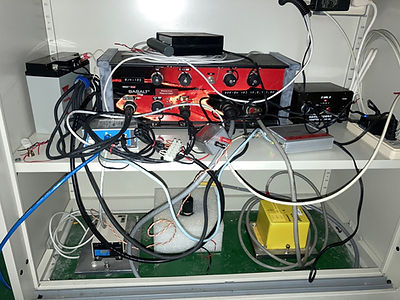
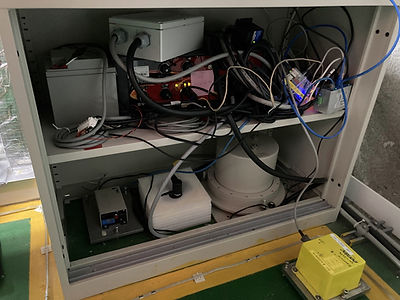
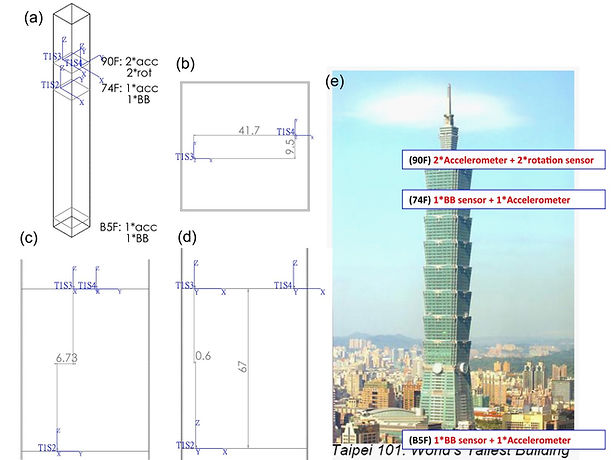
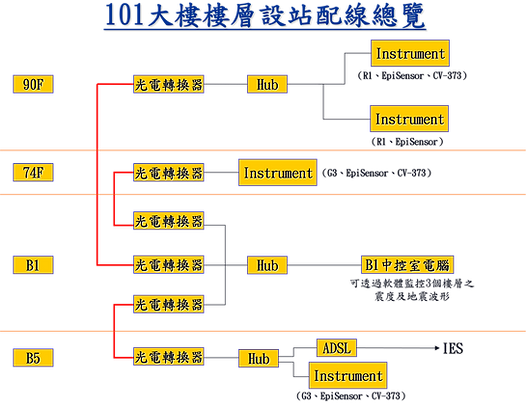
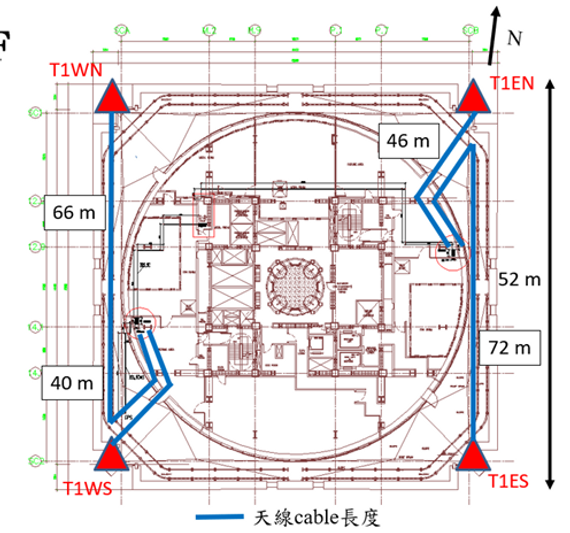
The dynamic responses of structures, such as natural frequency, damping, and mode shape, are typically calculated using observation data from accelerometers. However, long-period (low-frequency) static responses cannot be accurately derived due to the instability caused by accumulated errors during the double time integration process of acceleration data to obtain displacement. On the other hand, GNSS technology, which simultaneously receives multi-constellation and multi-frequency satellite signals, can provide real-time and high-resolution displacement information through Real-time Kinematic (RTK) positioning. This technology offers second-level temporal resolution and centimeter-level spatial resolution, delivering real-time, stable, and absolute displacement data. Moreover, with three or more GNSS units, it is possible to calculate additional parameters such as tilt and torsion. This study plans to install four GNSS observation systems on the upper floors of TAIPEI 101. These will be integrated with the existing seismic observation systems installed on three floors by the Institute of Earth Sciences, Academia Sinica. This setup will enable safety assessments of TAIPEI 101 following earthquakes and wind events, support the development of building health monitoring technologies, and provide a testing platform for GNSS instruments and techniques.
Nov. 2011 TMD monitor
The original system was installed by a Canadian company (Motioneering Inc.)
-
IoTech logger for accelerometer observations (6 channels)
-
CR510 logger for wind speed and direction observations
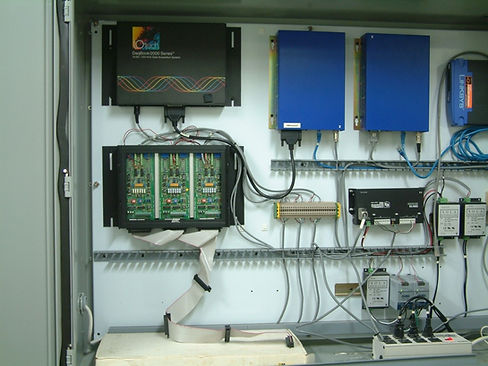
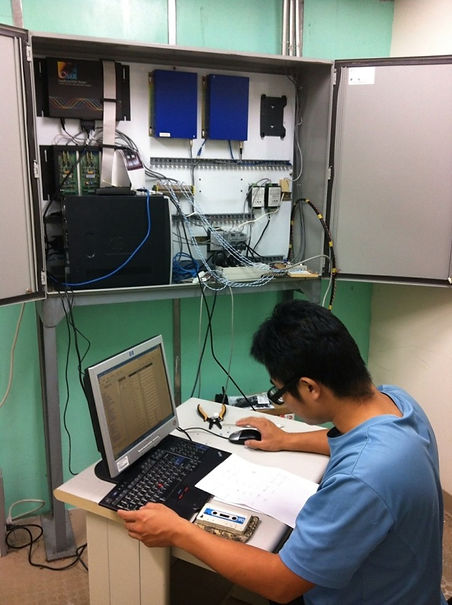
The Institute of Earth Sciences (IES), Academia Sinica took over the observations in November 2011
-
Utilized the same sensors
-
Replaced the data logger with an NI 6210, using a custom-written LabVIEW program for the observation system
-
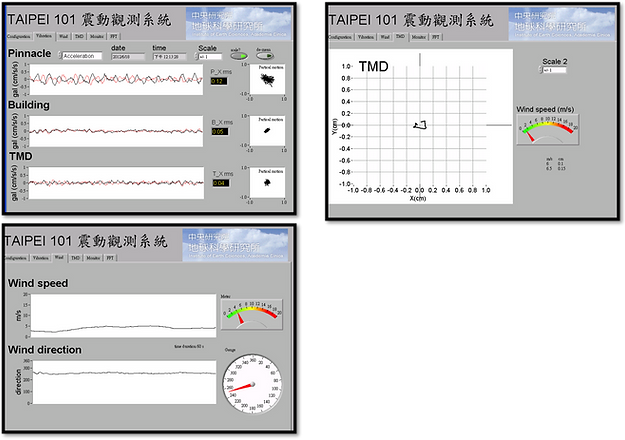
Provides real-time motion trajectory plots of the tuned mass damper (TMD)
-
Provides data storage and trajectory playback functionalities
-
An analog anti-alias filter was added to the NI DAQ front-end since 2012-05-30
-
Initiated synchronized observations with a Basalt seismic data logger starting on November 11, 2016
-
Enabled real-time data transmission for Basalt on June 16, 2023
July. 2010 Site construction
After hard work of negotiation with Nanao Park owned by the Forest Bureau, the site construction has begun. Mr. Wen- Hsiang Liu (劉文相) belongs to Electrical Laboratory of Institute of Earth Sciences, Academia Sinica and construction company 林輝蘭 takes responsibility for the site construction. The hole for HDPE tube is to be excavated in depth of 2 meter. HDPE tube is used for accommodating seismometer, digitizer, battery, transmission facility and so on. Size of HDPE tube is 1 meter in diameter and 2 meters in length. Power grounding and concrete wall for preventing flooding are also installed.